
A full-body bodyweight workout at home is one of the simplest ways to build strength, improve movement, and work toward a more defined core and stronger arms. You do not need expensive gym equipment or a large workout space to create an effective routine. Your own body can provide enough resistance for many challenging exercises.
Whether you are a beginner or already active, bodyweight training can be adjusted to match your fitness level. Exercises such as push-ups, planks, mountain climbers, squats, and triceps dips can train several muscle groups at once. When performed consistently with proper technique, these movements can help improve muscular endurance and overall fitness.
What Is a Full-Body Bodyweight Workout at Home?
A full-body bodyweight workout at home uses exercises in which your body provides most or all of the resistance. Instead of relying on dumbbells, weight machines, or barbells, you use movements such as pushing, squatting, lunging, holding, and climbing to challenge your muscles.
The advantage of this approach is flexibility. You can perform a workout in your bedroom, living room, garage, or another comfortable area with enough space to move safely. Because many bodyweight exercises involve multiple muscles simultaneously, a short session can provide a well-rounded training stimulus.
Why Focus on the Core and Arms?
Your core does much more than create a visibly defined midsection. The muscles around your abdomen, sides, lower back, and pelvis help stabilize your body during everyday movements and exercise. A stronger core can make movements such as pushing, squatting, bending, and balancing feel more controlled.
Your arms also play an important role in upper-body strength. Push-ups and similar movements challenge the chest, shoulders, and triceps, while exercises that require stabilization can make the arms work harder. Combining arm-focused exercises with full-body movements allows you to train several areas during the same session.
How to Warm Up Before Your Workout
A proper warm-up prepares your body for exercise by gradually increasing movement and raising your body temperature. Begin with several minutes of easy activity, such as marching in place, walking around your room, or gently moving your arms and shoulders.
Follow this with controlled movements such as arm circles, torso rotations, bodyweight squats, and alternating reverse lunges. Avoid turning the warm-up into a tiring workout. The goal is to prepare your muscles and joints so you can perform the main exercises with better control.
The Full-Body Bodyweight Workout at Home Routine
The following routine combines lower-body, upper-body, and core exercises. Beginners can start with fewer repetitions or shorter work periods, while more experienced exercisers can gradually increase the challenge.
Bodyweight Squats
Stand with your feet around shoulder-width apart and keep your chest comfortably lifted. Bend your knees and push your hips backward as if you were sitting into a chair. Lower yourself only as far as you can while maintaining good control, then press through your feet to return to standing.
Squats primarily train the lower body, but they also require your core to stabilize your torso. Perform about 10 to 15 controlled repetitions. Focus on smooth movement rather than rushing through each repetition.
Push-Ups
Push-ups are one of the most useful bodyweight exercises for the upper body. Begin in a high-plank position with your hands slightly wider than your shoulders. Keep your body in a relatively straight line as you bend your elbows and lower your chest toward the floor.
Press the floor away to return to the starting position. If standard push-ups are too difficult, place your hands on a stable elevated surface or perform them from your knees. Aim for 6 to 12 quality repetitions and gradually build your strength.
Forearm Plank
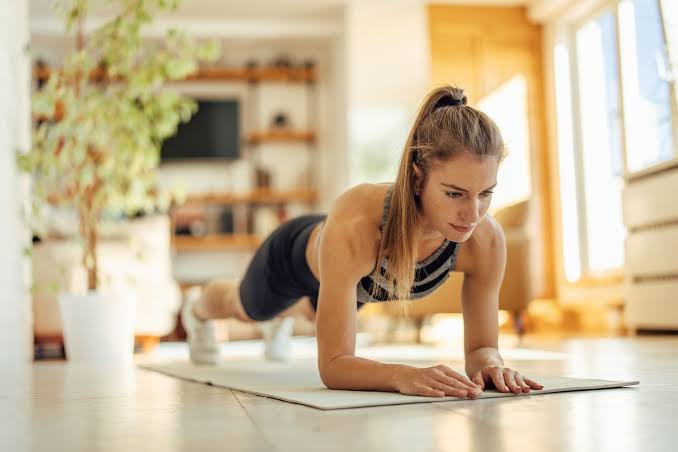
The forearm plank is a simple but demanding core exercise. Place your forearms on the floor with your elbows positioned approximately beneath your shoulders. Extend your legs behind you and maintain a stable body position.
Avoid letting your hips sag toward the floor or rise excessively. Start with a hold of around 20 to 30 seconds and increase the duration as your control improves. Breathing steadily throughout the hold is more useful than trying to stay rigid while holding your breath.
Reverse Lunges
Reverse lunges work the legs and glutes while requiring your core to help maintain balance. From a standing position, step one foot backward and lower your body under control. Push through the front foot to return to the starting position.
Alternate legs and keep your movements steady. You can begin with 8 to 10 repetitions per side. If balance is difficult, perform the movement beside a stable support that you can use lightly when necessary.
Mountain Climbers
Mountain climbers combine core stabilization with a faster movement pattern. Start in a high-plank position and bring one knee toward your chest before returning it to the starting position. Alternate sides in a controlled rhythm.
Beginners should prioritize technique over speed. Try 20 to 30 seconds of movement before resting. As your conditioning improves, you can gradually increase the work period while maintaining stable hips and controlled breathing.
Triceps Dips
Triceps dips can challenge the muscles at the back of your upper arms. Use a stable, secure surface if you choose this exercise. Place your hands behind you and carefully lower your body by bending your elbows before pressing back upward.
Keep the movement controlled and avoid dropping too deeply. If the exercise causes discomfort in your shoulders, stop and choose a different upper-body movement. You can also use close-grip push-ups as an alternative for targeting the triceps.
Glute Bridges
Lie on your back with your knees bent and feet positioned comfortably on the floor. Keep your arms beside your body and press through your feet to raise your hips. Pause briefly at the top before lowering under control.
Glute bridges primarily train the glutes and also involve the muscles around your hips and core. Complete approximately 12 to 15 repetitions. Avoid overextending your lower back at the top of the movement.
How to Structure Your Workout
A practical beginner session can include 10 to 15 squats, 6 to 12 push-ups, a 20- to 30-second plank, 8 to 10 reverse lunges per side, 20 to 30 seconds of mountain climbers, 8 to 12 controlled triceps dips, and 12 to 15 glute bridges.
Rest briefly between exercises and take a longer recovery period after completing the entire circuit. Beginners can complete one or two rounds, while people with more experience may perform three or more rounds depending on their fitness level and recovery.
How to Make the Routine More Challenging
Your body adapts when it repeatedly receives the same training stimulus. To continue progressing, you can gradually make exercises more demanding rather than simply performing the same routine indefinitely.
You might increase repetitions, extend plank or work intervals, reduce unnecessary rest, or choose a more challenging variation. For example, incline push-ups can eventually progress toward standard push-ups, while regular squats can progress toward slower-tempo or split-squat variations.
How Often Should You Do This Workout?
The ideal frequency depends on your current fitness level, recovery, and other physical activities. For many people, performing a challenging full-body bodyweight routine several times per week can provide a useful foundation.
Recovery days are important because your muscles need time to adapt. You can remain active on those days with comfortable walking, mobility exercises, stretching, or other low-intensity activities. Consistency over weeks and months is generally more valuable than attempting extremely difficult workouts every day.
Nutrition and Recovery for Better Results
Exercise is only one part of improving body composition and fitness. A balanced eating pattern that provides adequate protein, carbohydrates, healthy fats, vitamins, minerals, and fluids can support training and recovery.
Sleep is equally important. Consistently getting enough quality sleep can help you feel more prepared for workouts and recover between sessions. Instead of searching for a single food or supplement that promises instant results, focus on sustainable habits that you can maintain.
Common Mistakes to Avoid
One common mistake is trying to perform every exercise as quickly as possible. Speed can reduce control and make it harder to maintain good technique. Slow down when necessary and focus on performing each movement through a comfortable range of motion.
Another mistake is expecting visible changes immediately. Building strength and changing body composition take time. Your results can also be influenced by nutrition, sleep, genetics, activity levels, and consistency. Track improvements in strength, repetitions, endurance, and technique instead of relying only on appearance.
Tips for Staying Consistent at Home
One of the biggest benefits of home workouts is convenience, but convenience does not automatically create consistency. Choose a realistic time for training and make your routine easy to repeat. Even a shorter session can be useful when a longer workout does not fit your schedule.
Keep your workout area clear and prepare anything you need before starting. You can also record your repetitions or workout duration so you can see gradual progress. Small improvements can provide motivation and make long-term training more rewarding.
Conclusion
A full-body bodyweight workout at home can be an effective way to train your entire body without needing a traditional gym. Movements such as squats, push-ups, planks, lunges, mountain climbers, and glute bridges combine strength, stability, and muscular endurance in one convenient routine.
The key is to focus on proper technique, gradual progression, adequate recovery, and consistency. Your core and arms can become stronger as you build your overall fitness, but meaningful changes require patience and regular effort. Start at a level that feels manageable and gradually increase the challenge as your abilities improve.
FAQs
Can I do a full-body bodyweight workout at home every day?
It is usually better to give heavily trained muscles time to recover between challenging sessions. On rest days, you can choose gentle movement or mobility work instead.
Can bodyweight workouts tone my arms?
Bodyweight exercises can strengthen the muscles in your arms and upper body. Visible definition also depends on overall body composition, nutrition, genetics, and consistency.
How long should a home bodyweight workout last?
A useful session can take roughly 20 to 40 minutes depending on your fitness level, rest periods, and number of exercises. Quality is more important than simply making the workout longer.
Are bodyweight workouts suitable for beginners?
Yes. Many exercises can be modified to make them easier. Beginners should start with manageable repetitions and focus on learning proper movement patterns.
How can I make bodyweight exercises harder?
You can increase repetitions, extend work intervals, reduce rest gradually, slow down the movement, or progress to a more challenging exercise variation.
Do I need equipment for this workout?
No. The core routine can be performed without traditional exercise equipment. A workout mat can make floor exercises more comfortable, but it is not essential.
Can bodyweight workouts help with weight management?
Regular physical activity can contribute to overall energy expenditure and fitness. Weight management also depends on dietary intake, daily activity, sleep, and other individual factors.
How long does it take to see results?
Results vary from person to person. Strength and endurance may improve before noticeable physical changes occur, so focus on consistent training and measurable performance improvements.
