
Building muscle does not always require a gym membership, expensive machines, or a collection of dumbbells. Bodyweight exercises for beginners provide a practical way to develop strength and muscle using the resistance of your own body. Whether you are exercising at home, traveling, or simply starting your fitness journey, these movements can help you establish a strong foundation.
The key to building muscle without weights is not simply doing as many repetitions as possible. Effective training requires proper technique, controlled movements, enough resistance, progressive difficulty, adequate nutrition, and consistent recovery. When these elements work together, bodyweight training can become a challenging and productive muscle-building method.
Why Bodyweight Exercises Are Effective for Beginners
Bodyweight training uses your own body as resistance. Exercises such as squats, push-ups, lunges, glute bridges, and planks can challenge several muscles at once while also improving coordination and stability. For beginners, this makes bodyweight movements an excellent starting point because the exercises can often be modified according to your current ability.
Another advantage is accessibility. You can perform many movements in a bedroom, living room, park, or other suitable space. Instead of worrying about heavy equipment, you can focus on learning correct movement patterns. Once basic exercises become easier, you can increase repetitions, slow down the movement, change exercise variations, or reduce rest periods to continue challenging your muscles.
Best Bodyweight Exercises for Beginners
Push-Ups for the Chest and Upper Body
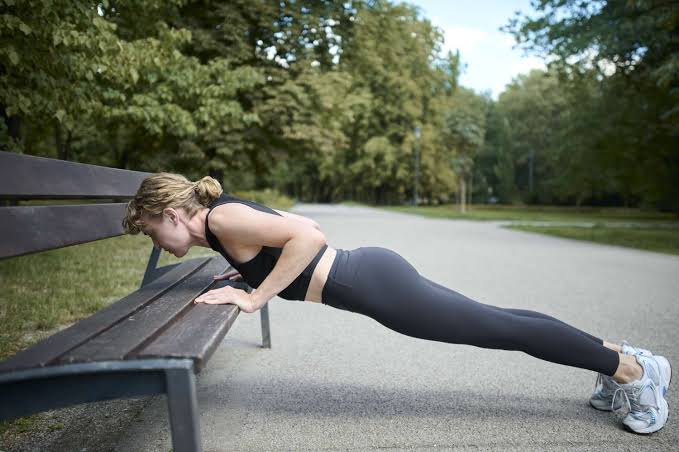
Push-ups are one of the most useful exercises for developing upper-body strength. They primarily train the chest, shoulders, and triceps while requiring your core to stabilize the body. Beginners who cannot perform standard push-ups can start with wall push-ups or incline push-ups using a sturdy elevated surface.
As strength improves, gradually move toward knee push-ups and eventually standard push-ups. Keep your body controlled throughout every repetition rather than allowing your hips to sag or rushing through the movement. A slower, controlled repetition can make the exercise considerably more demanding.
Bodyweight Squats for the Lower Body
Squats are a foundational lower-body movement that targets the quadriceps, glutes, and supporting muscles. Stand with your feet approximately shoulder-width apart and lower your hips while keeping your chest reasonably upright. Push through your feet to return to the starting position.
Beginners should first concentrate on comfortable depth and proper control. Once regular squats become easy, you can increase repetitions, pause near the bottom, use slower lowering phases, or progress toward more demanding variations such as split squats and single-leg movements.
Lunges for Stronger Legs
Lunges are particularly useful because they train one side of the body at a time. They challenge the quadriceps and glutes while also requiring balance and stability. A basic forward or reverse lunge can be performed without equipment and adjusted to suit your fitness level.
Reverse lunges are often a comfortable starting point because stepping backward can make it easier to control the movement. Keep your front foot stable and avoid allowing your knee to collapse inward. As your balance and strength improve, you can increase repetitions or progress to more challenging lunge variations.
Glute Bridges for the Hips and Glutes
Glute bridges are a beginner-friendly exercise for training the glutes and posterior chain. Lie on your back with your knees bent and feet positioned on the floor. Lift your hips while squeezing your glutes, then lower yourself under control.
This movement can be especially useful for beginners who spend much of the day sitting. Instead of simply moving quickly through repetitions, concentrate on creating tension in the glutes at the top of each repetition. Single-leg glute bridges provide a natural progression once regular bridges become comfortable.
Planks for Core Strength
A strong core helps support many other exercises. Planks train the abdominal region along with several muscles responsible for maintaining body stability. Start with a short hold while maintaining a straight and controlled body position.
You do not need to hold a plank for several minutes to make progress. Quality is more important than extreme duration. As your core becomes stronger, gradually increase your hold time or experiment with more demanding variations.
How to Build Muscle Without Weights
Muscle growth depends on providing your muscles with a sufficient training stimulus and then giving your body the resources required to recover. Bodyweight training can create this stimulus when exercises are difficult enough to challenge the target muscles.
One of the most important principles is progressive overload. With traditional weight training, progression often means adding more weight. With bodyweight training, progression can come from increasing repetitions, improving range of motion, slowing the eccentric portion of an exercise, adding pauses, reducing assistance, or selecting a harder variation.
For example, if ten regular squats become easy, performing more repetitions is one option. You could also introduce a pause at the bottom or progress to Bulgarian split squats. The goal is to gradually increase the challenge rather than repeating exactly the same workout indefinitely.
A Simple Beginner Bodyweight Workout Routine
A beginner routine should train the major movement patterns without overwhelming the body. Start with a short warm-up involving easy movement, joint mobility, and gradually increasing activity. Then perform exercises that cover both the upper and lower body.
A practical session could begin with bodyweight squats, followed by incline or standard push-ups, reverse lunges, glute bridges, and a plank. Perform a manageable number of repetitions for each movement and rest when necessary. Beginners should prioritize technique instead of trying to reach exhaustion on every set.
You can train two or three times per week while allowing recovery days between challenging sessions. As your fitness improves, gradually increase the workload. Consistency matters more than creating an extremely difficult workout during your first week.
How to Progress With Bodyweight Training
Progression is what turns simple movements into an effective long-term training system. When an exercise becomes easy, you need to give your muscles a new challenge. However, progression should happen gradually rather than through random increases in workout volume.
You might begin with wall push-ups, progress to incline push-ups, then knee push-ups, and eventually standard push-ups. Similarly, regular squats can progress to split squats, Bulgarian split squats, and controlled single-leg variations. These progressions allow you to increase difficulty without requiring traditional weights.
Tempo can also make a major difference. Taking three or four seconds to lower your body during a squat or push-up increases the amount of time your muscles work. Pausing during the hardest portion of an exercise can create additional difficulty while encouraging better control.
Common Mistakes Beginners Should Avoid
One common mistake is focusing exclusively on repetition numbers. Completing 30 poorly performed repetitions is not necessarily better than completing 10 controlled repetitions. Poor technique can reduce the effectiveness of an exercise and may increase unnecessary strain.
Another mistake is training the same muscles hard every day. Muscles need time to recover after demanding workouts. Beginners may feel motivated to exercise constantly, but sustainable progress usually comes from balancing training with rest, sleep, and appropriate nutrition.
Skipping progression is another problem. If your workout remains identical for months, your body may adapt and the stimulus may become insufficient. Keep track of your exercises and gradually make them more challenging as your strength develops.
Nutrition for Building Muscle Without Weights
Training provides the stimulus for adaptation, but nutrition supplies the materials your body needs to recover. A balanced diet containing adequate protein, carbohydrates, healthy fats, fruits, vegetables, and fluids can support an active lifestyle.
Protein is particularly important because it provides amino acids involved in muscle repair and growth. Foods such as eggs, fish, poultry, dairy products, beans, lentils, tofu, and other protein-rich foods can be included according to your dietary preferences.
Carbohydrates can also support training by providing energy for physical activity, while dietary fats contribute to overall nutrition. Rather than relying on a single “muscle-building” food, focus on consistently eating a balanced diet that matches your energy and fitness goals.
Recovery and Rest Matter
Muscles do not grow simply because you exercise them. Recovery is an essential part of the process. After challenging training, your body needs sufficient rest and nutrition to adapt to the workload.
Sleep is especially important. Establishing a consistent sleep routine can help support physical recovery and overall performance. Rest days can also be useful, particularly when your muscles remain sore or fatigued after previous sessions.
Recovery does not necessarily mean complete inactivity. Light walking, gentle mobility work, and normal daily movement can be appropriate between demanding workouts. Pay attention to how your body feels and avoid repeatedly training through significant pain.
How to Stay Consistent With Bodyweight Training
Consistency becomes easier when workouts fit naturally into your lifestyle. You do not need to spend an hour exercising every day to make progress. A focused session can be effective when it includes challenging movements and is performed regularly.
Set realistic goals that you can maintain. Instead of promising yourself an intense workout every day, establish a schedule that you are confident you can follow. Once exercise becomes a routine, increasing the difficulty becomes much easier.
Tracking your progress can also provide motivation. Record exercises, repetitions, sets, and variations. Over time, seeing yourself progress from an easier variation to a more demanding one can demonstrate that your strength is improving even without traditional gym equipment.
Conclusion
Bodyweight exercises for beginners offer an accessible way to build strength and develop muscle without relying on weights. Push-ups, squats, lunges, glute bridges, and planks can train the major muscle groups while helping beginners develop coordination and movement control. The most important factors are proper technique, gradual progression, sufficient nutrition, and consistent recovery.
You do not need complicated equipment to begin building a stronger body. Start with movements you can perform safely, practice them consistently, and gradually increase the challenge as your abilities improve. With patience and a well-structured routine, bodyweight training can become a powerful part of a long-term fitness program.
FAQs
Can beginners build muscle with bodyweight exercises?
Yes. Beginners can build muscle through challenging bodyweight movements when they train consistently and gradually increase difficulty. Proper nutrition and recovery also play important roles.
How often should beginners do bodyweight workouts?
Many beginners can start with two or three training sessions per week. Recovery days between challenging workouts can help the body adapt to training.
Are push-ups enough to build the upper body?
Push-ups are useful for the chest, shoulders, and triceps, but a balanced routine should include different movements to train other areas of the upper body and back.
How many repetitions should beginners perform?
There is no single number that works for everyone. Choose a repetition range that allows you to maintain good technique while making the final repetitions challenging.
Can bodyweight exercises build muscle without gym equipment?
Yes. Bodyweight movements can provide substantial resistance, particularly when you progress to harder variations and use controlled movement.
How long does it take to see results?
Results vary according to training consistency, nutrition, sleep, genetics, and starting fitness level. Strength improvements may appear before visible changes in muscle size.
Should beginners exercise every day?
Daily movement is fine, but demanding strength workouts do not necessarily need to be performed every day. Allowing muscles time to recover can support continued progress.
What is the best bodyweight exercise for beginners?
There is no single best exercise. A combination of movements such as squats, push-ups, lunges, glute bridges, and core exercises provides a more balanced starting routine.
