
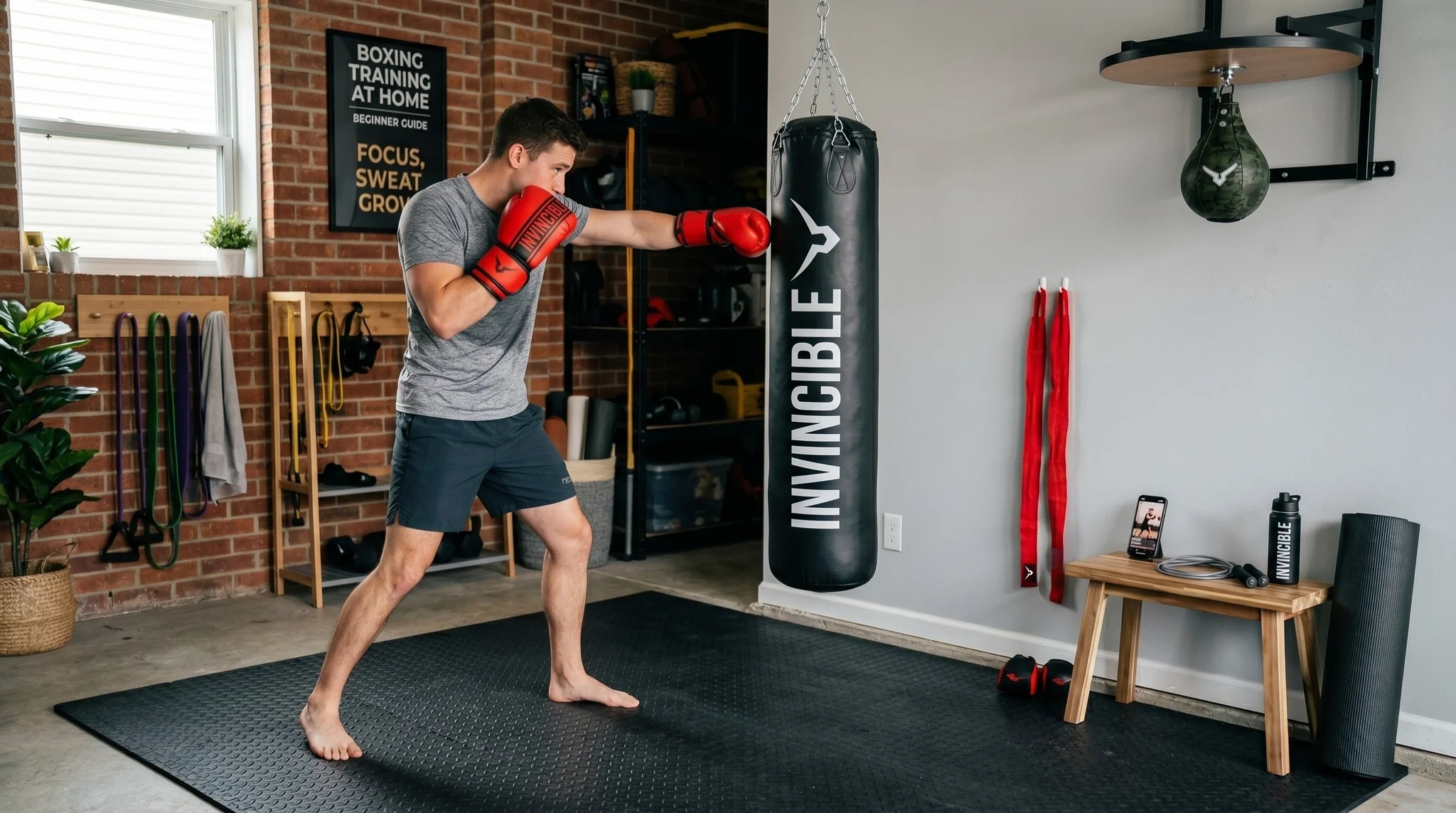
Boxing is often associated with heavy bags, boxing rings, gloves, and expensive gym equipment. However, you do not need a punching bag to learn the fundamentals or enjoy an effective boxing workout. A well-designed beginner boxing workout without a punching bag can help improve coordination, cardiovascular fitness, balance, speed, and overall body control using nothing more than your body and a little open space.
Shadowboxing is the key to training without a bag. It allows beginners to practice punches, defensive movements, footwork, combinations, and rhythm while imagining an opponent in front of them. When combined with bodyweight exercises and short cardio intervals, shadowboxing can become a challenging full-body workout that you can perform at home.
Why Try a Beginner Boxing Workout Without a Punching Bag?
A boxing workout without equipment is convenient because you can train almost anywhere. You only need enough space to move your feet and extend your arms safely. This makes it a practical option for people who want to exercise at home, travel frequently, or simply want to learn basic boxing movements before joining a boxing gym.
Shadowboxing also encourages you to focus on technique rather than relying on the resistance of a heavy bag. You can concentrate on keeping your hands up, rotating your hips, maintaining balance, moving correctly, and returning every punch to your guard. These fundamentals are important for beginners because good technique should come before trying to punch as hard or as fast as possible.
What You Need Before Starting
The simplest setup requires comfortable workout clothing, supportive shoes, water, and a clear area where you can move freely. A mirror can also be useful because it lets you watch your stance, guard position, and punching technique while you train. Although gloves are not necessary for shadowboxing, some beginners enjoy wearing lightweight boxing gloves to create a more familiar training experience.
Your workout area should be free from furniture, slippery surfaces, and objects that could cause you to trip. Give yourself enough room to extend your arms without hitting walls or other objects. If you have joint problems, previous injuries, or other health concerns, consider getting appropriate professional guidance before beginning a new exercise routine.
Start With a Proper Boxing Stance
Before throwing punches, learn how to stand correctly. A basic boxing stance gives you stability while allowing you to move quickly. If you are right-handed, place your left foot slightly forward and keep your right foot behind you. Left-handed boxers can reverse the position. Keep your feet approximately shoulder-width apart rather than standing with them directly in line.
Bend your knees slightly and keep your weight balanced between both legs. Bring your hands toward your face, keeping your elbows relatively close to your body. Your chin should remain slightly tucked, and your eyes should look forward. Avoid standing too rigidly because boxing requires constant movement and adjustment.
Learn the Basic Boxing Punches
The most important punches for beginners are the jab, cross, hook, and uppercut. Learning these movements slowly gives you a foundation for combinations later. The jab is usually thrown with the lead hand and is one of the easiest punches to learn. Extend the arm smoothly while keeping the opposite hand near your face, then bring the punching hand back to your guard.
The cross is a straight punch from the rear hand and involves rotation through the hips and shoulders. Hooks travel in a curved path and require controlled rotation rather than simply swinging the arm. Uppercuts travel upward and should be performed with control. When shadowboxing, do not lock your elbows or throw punches recklessly. The goal is controlled movement, not maximum force.
Beginner Boxing Workout Without a Punching Bag
Once you understand your stance and basic punches, you can build a simple workout around shadowboxing. Begin with a five-minute warm-up that includes marching, light jogging in place, arm circles, shoulder movements, and gentle bodyweight movements. The purpose is to gradually increase your body temperature and prepare your muscles for activity.
After warming up, perform several rounds of controlled shadowboxing. A beginner can start with three rounds of two minutes each, followed by approximately one minute of easy recovery between rounds. During the first round, focus on your stance and jab. In the second round, introduce the cross and simple jab-cross combinations. During the third round, add hooks, uppercuts, defensive movements, and footwork as your confidence improves.
Add Footwork to Your Routine
Good boxing is about more than throwing punches. Footwork helps you maintain balance, create angles, control distance, and move efficiently. Beginners can practice stepping forward, backward, left, and right while keeping their feet underneath their body. Take small controlled steps rather than making exaggerated movements.
Try combining footwork with simple punches. For example, move forward while throwing a jab, step backward while returning to your guard, and then practice a jab-cross combination. You can also move laterally while shadowboxing. Keep your movements smooth and avoid crossing your feet because doing so can make you unstable.
Use Shadowboxing for Cardio
Shadowboxing can become an effective cardiovascular activity when you maintain continuous movement. Instead of standing still and throwing occasional punches, keep your feet active and use combinations at a controlled pace. You can alternate between faster and slower periods to make the session more challenging.
A simple interval approach is to shadowbox at a moderate pace for 30 seconds, increase your speed for 20 seconds, and then move lightly for 10 seconds. Repeat the pattern throughout a round. Beginners should prioritize technique and breathing rather than trying to maintain maximum speed for the entire workout.
Include Bodyweight Exercises
Adding bodyweight movements can turn a boxing session into a broader full-body workout. Exercises such as squats, lunges, mountain climbers, push-ups, and plank variations can complement shadowboxing by challenging different muscle groups.
For example, you might shadowbox for two minutes and then perform a short set of squats before returning to punching combinations. The exercises do not need to be complicated. The goal is to build an enjoyable training session that develops conditioning while allowing you to continue practicing boxing fundamentals.
A Simple 20-Minute Home Boxing Routine
A 20-minute session is enough for beginners to practice the basics without making the workout unnecessarily complicated. Spend the first five minutes warming up with light movement and mobility exercises. Follow this with two minutes of basic shadowboxing focused on stance, guard, and the jab.
Next, complete another two-minute round using jab-cross combinations and simple forward and backward movement. Take a short recovery period and then perform another two-minute round incorporating hooks and uppercuts. Finish the boxing portion with defensive movements such as slips and controlled changes in direction.
Use the final few minutes for bodyweight exercises and a gradual cooldown. If you are new to exercise, start with shorter sessions and increase the duration gradually. Quality movement is more valuable than simply trying to complete a longer workout.
How to Practice Defense Without Equipment
Defense can be practiced effectively during shadowboxing. Beginners can start with simple slips, which involve moving the head slightly to one side while maintaining balance and keeping the hands near the face. You can also practice ducking movements, controlled backward steps, and changes in direction.
Imagine that an opponent is throwing punches toward you. After throwing a combination, visualize a punch coming back and practice moving away from it. For example, throw a jab-cross, return to your guard, perform a small slip, and then move your feet. This approach makes shadowboxing more realistic and keeps your attention focused throughout the round.
Common Mistakes Beginners Should Avoid
One of the most common mistakes is trying to punch as hard as possible while shadowboxing. There is no physical target to absorb your punches, so excessive force can encourage poor mechanics and unnecessary joint stress. Focus instead on accuracy, control, speed, and returning your hands to the guard position.
Another common problem is forgetting about the lower body. Beginners sometimes stand in one place and move only their arms. Boxing involves the entire body, so practice connecting your feet, legs, hips, torso, shoulders, and arms. It is also important not to hold your breath. Relaxed breathing can help you maintain a steady rhythm and avoid tiring too quickly.
How Often Should Beginners Practice?
Consistency is more important than trying to train intensely every day. A beginner can start with two or three boxing sessions per week and gradually increase training frequency as their fitness and technique improve. Rest days give your body an opportunity to recover and can help you return to training with better energy.
Each session does not have to be long. Even a focused 15- to 30-minute workout can provide useful practice. As your coordination improves, you can gradually increase the number of rounds, introduce more combinations, and make your footwork more complex.
How to Progress Without a Punching Bag
You can continue progressing even if you never purchase a heavy bag. One way is to increase the complexity of your combinations. Start with single punches, progress to two-punch combinations, and eventually practice longer sequences involving movement and defense.
You can also improve your conditioning by increasing round duration or reducing unnecessary rest. Another option is to use a mirror and carefully analyze your stance and movement. Recording yourself occasionally can help you notice habits such as dropping your hands, standing too upright, overextending punches, or losing balance.
Benefits of Shadowboxing at Home
A home boxing workout can provide several fitness benefits. Continuous movement can challenge your cardiovascular system, while punching combinations require coordination between the upper and lower body. Footwork and defensive movements also challenge balance and body awareness.
Shadowboxing can be mentally engaging as well. Remembering combinations, reacting to imagined attacks, and maintaining rhythm require concentration. Because you can vary the movements from round to round, the workout can remain interesting instead of feeling repetitive.
Conclusion
A beginner boxing workout without a punching bag is an accessible way to start learning fundamental boxing movements while improving your overall fitness. With shadowboxing, you can practice your stance, punches, combinations, defense, footwork, and conditioning without expensive equipment. The most important goal is to develop control and proper movement rather than focusing on power.
Start slowly, keep your technique clean, and gradually increase the challenge as you become more comfortable. A small amount of open space, consistent practice, and a structured routine can be enough to create productive boxing sessions at home. With patience and regular training, your coordination, stamina, movement, and confidence can steadily improve.
FAQs
Can I learn boxing without a punching bag?
Yes. Shadowboxing allows beginners to practice many fundamental boxing movements without a bag. However, training with a qualified coach can provide useful feedback on technique and safety.
Is shadowboxing good for beginners?
Yes. Shadowboxing is particularly useful for beginners because it allows you to practice basic punches, movement, combinations, and defense at a controlled pace.
How long should a beginner boxing workout last?
Beginners can start with approximately 15 to 30 minutes. As conditioning improves, you can gradually increase the number and duration of your rounds.
Can shadowboxing help improve fitness?
Yes. Continuous shadowboxing can raise your heart rate while challenging coordination, balance, movement, and muscular endurance.
Do I need boxing gloves for shadowboxing?
No. Gloves are not required for shadowboxing because you are not striking a physical target. Comfortable clothing and enough space to move safely are more important.
How many times a week should I shadowbox?
Two or three sessions per week can be a reasonable starting point for many beginners. Allow enough recovery between challenging workouts.
What punches should beginners learn first?
Start with the jab and cross before progressing to hooks and uppercuts. Once those movements become comfortable, combine them with footwork and defensive actions.
Can I do boxing workouts at home?
Yes. A clear, safe training area can be enough for basic boxing practice. You can combine shadowboxing with footwork, bodyweight exercises, and cardio intervals for a complete home session.
